

Maps Of The Canadian Shield
| Canadian Shield | |
|---|---|
| Stratigraphic range: | |
| Type | Shield |
| Unit of | North American craton |
| Sub-units | Laurentian Upland Kazan[ane] |
| Area | viii,000,000 km2 [2] |
| Location | |
| Coordinates | 52°00′N 71°00′W / 52.000°Northward 71.000°W / 52.000; -71.000 Coordinates: 52°00′N 71°00′W / 52.000°N 71.000°Westward / 52.000; -71.000 |
| Region | Due north America |
| Country | Canada U.s. Greenland |
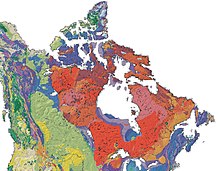 The Canadian Shield is a broad region of Precambrian rock (pictured in shades of scarlet) that encircles Hudson Bay. It spans eastern, northeastern, and east-key Canada and the upper midwestern U.s.. | |
The Canadian Shield (French: Bouclier canadien [buklje kanadjɛ̃]), also called the Laurentian Plateau, is a geologic shield, a big area of exposed Precambrian igneous and high-grade metamorphic rocks. It forms the N American Craton (or Laurentia), the ancient geologic core of the Northward American continent. Glaciation has left the expanse with only a thin layer of soil, through which exposures of igneous bedrock resulting from its long volcanic history are oft visible.[3] As a deep, common, joined boulder region in eastern and central Canada, the Shield stretches n from the Bully Lakes to the Arctic Sea, roofing over one-half of Canada and most of Greenland; information technology besides extends south into the northern reaches of the United States.
Geographical extent [edit]
The Canadian Shield is a physiographic division comprising four smaller physiographic provinces: the Laurentian Upland, Kazan Region, Davis and James.[1] The shield extends into the United States every bit the Adirondack Mountains (continued past the Frontenac Centrality) and the Superior Upland. The Canadian Shield is a U-shaped subsection of the Laurentia craton signifying the area of greatest glacial bear upon (scraping down to bare rock) creating the thin soils. The Canadian Shield is more iii.96 billion years erstwhile. The Canadian Shield once had jagged peaks, college than any of today's mountains, but millions of years of erosion have changed these mountains to rolling hills.[four]
The Canadian Shield is a collage of Archean plates and accreted juvenile arc terranes and sedimentary basins of the Proterozoic Eon that were progressively amalgamated during the interval 2.45–one.24 Ga, with the most substantial growth menses occurring during the Trans-Hudson orogeny, between c. ane.ninety–1.80 Ga.[five] The Canadian Shield was the first part of Northward America to be permanently elevated above sea level and has remained virtually wholly untouched by successive encroachments of the sea upon the continent. It is the Globe's greatest area of exposed Archean rock. The metamorphic base rocks are generally from the Precambrian (between 4.five billion and 540 million years ago) and have been repeatedly uplifted and eroded. Today it consists largely of an area of low relief 300–610 m (980–ii,000 ft) in a higher place sea level with a few monadnocks and depression mountain ranges (including the Laurentian Mountains) probably eroded from the plateau during the Cenozoic Era. During the Pleistocene Epoch, continental ice sheets depressed the state surface (creating Hudson Bay) simply likewise tilted upwardly its northeastern "rim" (the Torngat), scooped out thousands of lake basins, and carried away much of the region'south soil. The northeastern portion, however, became tilted up so that, in northern Labrador and Baffin Island, the land rises to more 1,500 metres (5,000 feet) higher up sea level.
When the Greenland section is included, the Canadian Shield is approximately circular, divisional on the northeast past the northeast border of Greenland, with Hudson Bay in the centre. It covers much of Greenland, all of Labrador and the Groovy Northern Peninsula of Newfoundland, most of Quebec north of the St. Lawrence River, much of Ontario including northern sections of the Ontario Peninsula, the Adirondack Mountains[6] of New York, the northernmost part of Lower Michigan and all of Upper Michigan, northern Wisconsin, northeastern Minnesota, the primal and northern portions of Manitoba abroad from Hudson Bay, northern Saskatchewan, a pocket-sized portion of northeastern Alberta,[7] mainland Northwest Territories to the east of a line extended north from the Saskatchewan-Alberta edge, virtually of Nunavut's mainland and, of its Arctic Archipelago, Baffin Island and pregnant bands through Somerset, Southampton, Devon and Ellesmere islands.[2] In full, the exposed area of the Shield covers approximately 8,000,000 kmtwo (three,100,000 sq mi). The true extent of the Shield is greater still and stretches from the Western Cordillera in the west to the Appalachians in the east and every bit far south equally Texas, only these regions are overlaid with much younger rocks and sediment.

Panorama of Canadian Shield geography in the Flin Flon, Manitoba, region. Large Island Lake is in the background.
Geology [edit]
The Canadian Shield is amongst the oldest on Globe, with regions dating from ii.five to four.2 billion years.[8] The multitude of rivers and lakes in the region is classical example of a deranged drainage system, acquired by the watersheds of the area being disturbed by glaciation and the upshot of post-glacial rebound.[9] The Shield was originally an surface area of very large, very tall mountains (about 12,000 m or 39,000 ft)[10] with much volcanic activity, but the area was eroded to well-nigh its current topographic appearance of relatively low relief over 500 million years ago.[11] [12] Erosion has exposed the roots of the mountains, which take the grade of greenstone belts in which belts of volcanic stone that have been altered by metamorphism are surrounded by granitic rock. These belts range in age from 3600 to 2680 meg years one-time.[13] Much of the granitic stone belongs to the distinctive tonalite–trondhjemite–granodiorite family of rocks, which are characteristic of Archean continental crust.[xiv] Many of Canada's major ore deposits are associated with greenstone belts.[xv]
The Sturgeon Lake Caldera in Kenora District, Ontario, is 1 of the world's best preserved mineralized Neoarchean caldera complexes, which is 2.seven billion years old.[sixteen] The Canadian Shield likewise contains the Mackenzie dike swarm, which is the largest dike swarm known on Earth.[17]
Mountains have deep roots and float on the denser mantle much like an iceberg at sea. Every bit mountains erode, their roots rise and are eroded in turn. The rocks that now form the surface of the Shield were once far below the Earth's surface.
The loftier pressures and temperatures at those depths provided ideal conditions for mineralization. Although these mountains are now heavily eroded, many large mountains nevertheless exist in Canada's far n called the Arctic Cordillera. This is a vast, deeply dissected mountain range, stretching from northernmost Ellesmere Island to the northernmost tip of Labrador. The range's highest peak is Nunavut'south Barbeau Peak at 2,616 metres (8,583 ft) above sea level.[xviii] Precambrian rock is the major component of the boulder.
The Northward American craton is the bedrock forming the centre of the Northward American continent and the Canadian Shield is the largest exposed function of the craton'southward bedrock.
The Canadian Shield is function of an ancient continent called Arctica, which was formed well-nigh 2.5 billion years ago during the Neoarchean era. Information technology[ clarification needed ] was split[ when? ] into Greenland, Laurentia, Scotland, and Siberia, and is at present roughly situated in the Arctic effectually the electric current North Pole.
-
-

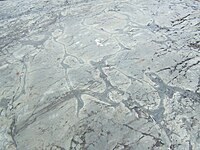
Typical Canadian Shield landscape: bandbox, lakes, bogs, and rock
Ecology [edit]

Typical shield landscape in a southern Ontario region with very few old growth copse, due to a history of logging and fires. Black River, Queen Elizabeth 2 Wildlands Provincial Park.
The current surface expression of the Shield is one of very thin soil lying on top of the bedrock, with many bare outcrops. This organization was caused past severe glaciation during the ice age, which covered the Shield and scraped the rock clean.
The lowlands of the Canadian Shield have a very dense soil that is not suitable for forestation; it also contains many marshes and bogs (muskegs). The rest of the region has coarse soil that does not retain moisture well and is frozen with permafrost throughout the year. Forests are not as dumbo in the north.
The Shield is covered in parts past vast boreal forests in the south that back up natural ecosystems too every bit a major logging industry. The boreal forest area gives fashion to the Eastern Canadian Shield taiga that covers northern Quebec and nigh of Labrador. The Midwestern Canadian Shield forests that run westwards from Northwestern Ontario have boreal forests that give way to taiga in the most northerly parts of Manitoba and Saskatchewan. Hydrologic drainage is generally poor, the soil compacting effects of glaciation being one of the many causes. Tundra typically prevails in the northern regions. Many mammals such every bit caribou, white-tailed deer, moose, wolves, wolverines, weasels, mink, otters, grizzly bear, polar bears and blackness bears are nowadays.[nineteen] In the case of polar bears ( Ursus maritimus ), the Shield expanse contains many of their denning locations, such equally the Wapusk National Park.[twenty]
Mining and economics [edit]
The Canadian Shield is one of the world's richest areas in terms of mineral ores. Information technology is filled with substantial deposits of nickel, gold, silver, and copper. Throughout the Shield at that place are many mining towns extracting these minerals. The largest, and one of the best known, is Sudbury, Ontario. Sudbury is an exception to the normal process of forming minerals in the Shield since the Sudbury Basin is an ancient meteorite impact crater. Ejecta from the meteorite bear upon was found in the Rove Germination in May 2007. The nearby but less-known Temagami Magnetic Anomaly has striking similarities to the Sudbury Basin. This suggests it could be a second metallic-rich impact crater.[21]
In northeastern Quebec, the giant Manicouagan Reservoir is the site of an extensive hydroelectric project (Manic-cinq, or Manic-5). This is one of the largest-known meteorite impact craters on Globe, though not as large as the Sudbury crater; it is currently ranked fifth, while Sudbury is 3rd.
The Flin Flon greenstone belt in primal Manitoba and e-primal Saskatchewan "is one of the largest Paleoproterozoic volcanic-hosted massive sulfide (VMS) districts in the world, containing 27 copper-zinc-(gold) deposits from which more than 183 million tonnes of sulfide take been mined."[22]
The Canadian Shield, particularly the portion in the Northwest Territories, has recently been the site of several major diamond discoveries. The kimberlite pipes in which the diamonds are found are closely associated with cratons, which provide the deep lithospheric mantle required to stabilize diamond as a mineral. The kimberlite eruptions then bring the diamonds from over 150 kilometres (93 mi) depth to the surface. The Ekati and Diavik mines are actively mining kimberlite diamonds.
See as well [edit]
- Athabasca Basin
- Geology of Ontario
- Platform (geology)
- Oldest rock
- Basement (geology)
- Volcanology of Canada
- Wisconsin Glaciation
- Glacial history of Minnesota
References [edit]
- ^ a b The Atlas of Canada (12 September 2016). "Physiographic Regions Map". Natural Resources Canada. Retrieved 2019-11-15 .
- ^ a b "Canadian Shield". Encyclopædia Britannica. Archived from the original on 2015-06-24. Retrieved 2009-02-10 .
- ^ Marshak, Stephen (2009). Essentials of geology (third ed.). New York: W.W. Norton. ISBN978-0393932386.
- ^ James-Abra, Erin. "Canadian Shield". Canadian Encyclopedia. Archived from the original on 11 January 2018. Retrieved 24 Jan 2018.
- ^ Corrigan, D. (2008). "Metallogeny and Tectonic Evolution of the Trans-Hudson Orogen" (PDF). Archived from the original (PDF) on April 9, 2008. Retrieved 2008-03-05 .
- ^ Peterson Field Guide to Geology of Eastern North America past Roberts, David & Roger Tory Peterson.
- ^ Alberta Heritage - Alberta Online Encyclopedia Archived 2010-12-08 at Annal-It - The Canadian Shield Region of Alberta
- ^ Tsuyoshi Iizuka, at al., "Geology and Zircon Geochronology of the Acasta Gneiss Complex", Precambrian Research, 153 (2007) pp. 179–208
- ^ Pidwirny, Thousand. (2006). "The Drainage Basin Concept". Fundamentals of Physical Geography (2nd ed.).
- ^ Clark, Bruce West. (1999). "Geologic History". Making Connections: Canada's geography. Scarborough, Ontario: Prentice Hall Ginn Canada. pp. 95. ISBN978-0-13-012635-1.
- ^ Ambrose, J. W. (one September 1964). "Exhumed paleoplains of the Precambrian Shield of North America". American Journal of Science. 262 (seven): 817–857. Bibcode:1964AmJS..262..817A. doi:10.2475/ajs.262.7.817.
- ^ Shilts, William West.; Aylsworth, Janice M.; Kaszycki, Christine A.; Klassen, Rodney A. (1987). "Canadian Shield". Geomorphic Systems of North America: 119–161. doi:10.1130/DNAG-CENT-v2.119. ISBN0813753023.
- ^ Carte du jour, K.D. (Baronial 1990). "A review of the Superior Province of the Canadian Shield, a product of Archean accretion". Precambrian Research. 48 (i–ii): 99–156. Bibcode:1990PreR...48...99C. doi:10.1016/0301-9268(90)90059-Y.
- ^ Smithies, R.H (15 October 2000). "The Archaean tonalite–trondhjemite–granodiorite (TTG) serial is not an analogue of Cenozoic adakite". Earth and Planetary Science Letters. 182 (1): 115–125. Bibcode:2000E&PSL.182..115S. doi:x.1016/S0012-821X(00)00236-3.
- ^ de Geoffroy, J.; Wignall, T. K. (1 May 1971). "A probabilistic appraisal of mineral resource in a portion of the Grenville Province of the Canadian shield". Economic Geology. 66 (3): 466–479. doi:10.2113/gsecongeo.66.iii.466.
- ^ Caldera Volcanoes Archived 2012-08-14 at the Wayback Machine Retrieved on 2007-07-20
- ^ Pilkington, Mark; Roest, Walter R. (1998). "Removing varying directional trends in aeromagnetic information". Geophysics. 63 (two): 446–453. Bibcode:1998Geop...63..446P. doi:10.1190/1.1444345.
- ^ "Barbeau Acme". Bivouac.com.
- ^ World Wild fauna Fund, ed. (2001). "Northern Canadian Shield taiga". WildWorld Ecoregion Profile. National Geographic Society. Archived from the original on 2010-03-08.
- ^ C. Michael Hogan (2008) Polar Bear: Ursus maritimus, Globaltwitcher.com, ed. Nicklas Stromberg Archived December 24, 2008, at the Wayback Automobile
- ^ 3-D Magnetic Imaging using Cohabit Gradients: Temagami anomaly Archived 2009-07-xi at the Wayback Machine Retrieved on 2008-03-12
- ^ Troymet Exploration, Written report on the 2007 Diamond Drilling Program, McClarty Lake Project, Manitoba: The Pas Mining District NTS 63-G-08; UTM ZONE xiv N 415938 Eastward, 6038968 North; 54° 29′ 28″ Due north 100° 17′ 52″ W, by Jessica Norris & Tracy Hurley (Whitehorse, Yukon: Aurora Geosciences, 2007‑09‑24).
Farther reading [edit]
- Schwartzenberger, Tina (2005), The Canadian Shield, Weigl Educational, ISBN ane-55388-141-9

Maps Of The Canadian Shield,
Source: https://en.wikipedia.org/wiki/Canadian_Shield
Posted by: wheatpopegets.blogspot.com
0 Response to "Maps Of The Canadian Shield"
Post a Comment