

Neutralization Of Hcl And Naoh
Enthalpy of Neutralisation or Heat of Neutralization Chemical science Tutorial
Key Concepts
⚛ Neutralisation, or neutralization, is the name given to the reaction that occurs between an Arrhenius acid and an Arrhenius base. (1)
H+ (aq) + OH- (aq) → H2O(l)
⚛ When an acid is added to an aqueous solution of base, the temperature of the solution increases.
Or, if a base is added to an aqueous solution of an acid, the temperature of the solution increases.
⚛ Energy (heat) is produced when an acrid reacts with a base in a neutralisation reaction.
· Neutralisation reactions are exothermic.
· ΔH for a neutralisation reaction is negative.
⚛ Molar enthalpy of neutralisation (molar heat of neutralization) is the energy liberated per mole of water formed during a neutralisation reaction.
· Δneut H (or ΔHneut) is the symbol given to the molar enthalpy of neutralisation. (2)
· Δneut H is usually given in units of kJ mol-one
(kJ of free energy released per mole of water produced)
⚛ Enthalpy of neutralisation can exist determined in the school laboratory using a styrofoam™ loving cup solution calorimter(iii). Computing the molar enthalpy of neutralisation from experimental results is a 3 step process:
Step 1: Calculate the heat evolved: q = m × C g × ΔT
one thousand = full mass of reaction mixture
C thousand = specific heat capacity of solution
ΔT = change in temperature of solution
Footstep 2: Calculate the enthalpy change for the reaction: ΔH = −q
Footstep 3: Calculate the molar enthalpy of neutralisation: Δneut H = ΔH ÷ n(H2O(50))
⚛ Molar enthalpy of neutralisation for reactions betwixt dilute aqueous solutions of strong acid and strong base of operations is always the same(4), that is,
Δneut H = -55.xc kJ mol -1
because no bonds need to exist cleaved, and considering making the H-O bonds in H2O releases energy
(breaking bonds is an endothermic process, making bonds is an exothermic process)
⚛ Less than 55.90 kJ mol-ane of free energy is released when:
(a) a weak acid neutralises a strong base of operations
(b) a potent acid neutralises a weak base
(c) a weak acid neutralises a weak base
considering some of the energy is consumed in the procedure of breaking weak acid bonds and/or weak base of operations bonds.
Please practise non block ads on this website.
No ads = no money for united states of america = no costless stuff for you!
Polstyrene Cup Calorimeter for Enthalpy of Neutralisation Experiment
Expanded polystyrene (polystyrene foam or styrofoam™) cups are often used every bit take-away java cups because the expanded polystyrene is a adept insulator, that is, your coffee stays hot but you don't fire your fingers holding the loving cup!
This aforementioned insulating property can be exploited to make a reasonably good calorimeter (a device used to measure out energy, or heat, modify during a chemic reaction).
A schematic diagram of a simple polystyrene foam cup calorimeter is shown below:
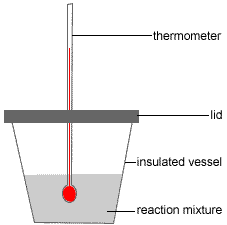
A known amount of a reactant, such every bit a dilute aqueous solution of a base of operations, is placed in the polystyrene cup (insulated vessel in the diagram).
The following information for this solution are recorded:
concentration: c ane = ? mol 50-1
volume = V 1 = ? mL
A small hole is placed in the polystyrene lid to allow a thermometer to be pushed through. The fit must be snug enough to agree the thermometer in place, suspended off the bottom of the cup and immersed in the reactant.
Information technology is assumed no heat volition be lost through the lid or the pigsty in the chapeau.
The intial temperature of the reactant is measured and recorded.
initial temperature = T i = ? °C
A known amount of the 2d reactant, for example a dilute solution of acid, at the same temperature is added to the solution in the cup.
The following data for this 2d solution are recorded:
concentration: c 2 = ? mol Fifty-ane
volume = Five two = ? mL
The thermometer is also used to stir the solution while the reaction is taking place.
The temperature of the solution in the cup volition ascent.
The maximum temperature reached is recorded every bit the final temperature.
final temperature = T f = ? °C
For the calculation of heat of neutralization (enthalpy of neutralisation) we need to make up one's mind:
(i) total mass, chiliad, of the solution in the cup
First presume additivity of volumes so that total volume of solution, V f, is the sum of the volume of the 2 reactants:
V f = V i + Five 2
Then assume that, considering all of the solutions are dilute aqueous solutions, the density of each solution and hence the density of the terminal solution, d, is the same equally water which nosotros will presume is 1.00 yard mL-1
density = mass (g) ÷ volume (mL)
Substitute the density of h2o into the equation:
1.00 (g/mL) = mass (g) ÷ V f (mL)
Multiplying both sides of the equation by Five f (mL)
V f (mL) × 1.00 (1000/mL) = Five f (mL) × mass (grand) ÷ V f (mL)
5 f × 1.00 = mass (thousand) = m k
(2) specific rut capacity, C g, of the solution
Assume that, considering all of the solutions are dilute aqueous solutions, the specific oestrus capacity of each solution and hence the specific oestrus capacity of the terminal solution, C one thousand, is the same as water which we will assume is four.eighteen J one thousand-1 °C-ane
C thou = four.18 J g-1 °C-1
(3) change in temperature, ΔT, as a upshot of the neutralisation reaction:
ΔT = (T f − T i) °C
Now we can calculate the heat released by this neutralisation reaction, q,
q = m × C 1000 × ΔT
In order to make up one's mind the tooth enthalpy of neutralisation (molar heat of neutralization), we demand to determine how many moles of water, n(H2O(l)), accept been formed as a result of the reaction:
H+ (aq) + OH- (aq) → HiiO(50)
And then, using the stoichiometric ratio (mole ratio), we can see that:
n(H+ (aq)) = n(OH- (aq)) = north(HiiO(l))
Now we can summate the energy released per mole of h2o, or the molar enthaply of neutralisation (molar estrus of neutralization), Δneut H
Remember, the reaction is exothermic so the sign of ΔH volition exist negative!
Δneut H = −q ÷ due north(HtwoO(l))
↪ Back to top
Enthalpy of Neutralisation: Strong Monoprotic Acid + Strong Monobasic Base
HCl(aq) is a potent monoprotic acid, it completely dissociates (ionises) in water to produce hydrogen ions (H+ (aq)) and chloride ions (Cl- (aq)):
HCl(aq) → H+ (aq) + Cl- (aq)
north(HCl(aq)) : n(H+ (aq)) is 1:one (that is, monoprotic)
NaOH(aq) is a strong monobasic base, it completely dissociates (ionises) in h2o to produce sodium ions (Na+ (aq)) and hydroxide ions (OH- (aq)):
NaOH(aq) → Na+ (aq) + OH- (aq)
n(NaOH(aq)) : n(OH- (aq)) is one:ane (that is, monobasic)
A neutralization reaction occurs when HCl(aq) is added to NaOH(aq)
HCl(aq) + NaOH(aq) → HtwoO(fifty) + NaCl(aq)
and heat energy is given off (the reaction is said to be exothermic)
In an experiment to determine the molar enthalpy of neutralisation, l.0 mL of ane.00 mol L-one NaOH(aq) is placed in the styrofoam loving cup.
The temperature of the NaOH(aq) is recorded.
one.00 mol 50-1 HCl(aq) at the same temperature is added 10.0 mL at a time.
The reaction mixture is stirred between each improver.
The maximum temperature the solution reached is then recorded.
The results of the experiment are shown in the tabular array below:
| total book HCl(aq) added (mL) | temperature in calorimeter (°C) |
|---|---|
| 0 | xviii.0 |
| 10 | 20.2 |
| xx | 21.8 |
| 30 | 22.9 |
| 40 | 23.8 |
| fifty | 24.6 |
| sixty | 24.0 |
| 70 | 23.6 |
and the results take been plotted on the graph shown below:
| temperature (°C) | HCl(aq) added to NaOH(aq) full volume of HCl(aq) added (mL) |
Initially, the temperature of the reaction mixture in the calorimeter (styrofoam™ cup) increases as HCl(aq) is added.
Energy (heat) is existence produced by the reaction.
The reaction is exothermic.
Maximum temperature reached is 24.6°C when 50.0 mL of HCl(aq) had been added.
When l.0 mL of the acid has been added, all the base has been neutralised.
HCl(aq) + NaOH(aq) → NaCl(aq) + H2O(l)
moles HCl(aq) added = moles of NaOH(aq) nowadays in the calorimeter
Adding more acid doesn't increment the temperature in the calorimeter any further(5).
We tin can calculate the molar enthalpy of neutralisation (molar oestrus of neutralization) for the reaction if we assume that the:
(i) density of each dilute aqueous solution is the same as h2o, 1 1000 mL-one at 25°C
so, the mass of solution in grams = volume of solution in mL
(2) heat capacity of each solution is the same as for h2o, C g = 4.18 J°C-1thousand-1
Calculating the molar enthalpy of neutralisation using the data from the experiment:
Footstep one: Extract the data needed to calculate the molar heat of neutralisation for this reaction:
5 (NaOH) = volume of NaOH(aq) in the calorimeter = 50.0 mL
V (HCl) = volume of HCl(aq) added to achieve neutralisation = 50.0 mL
c (NaOH) = concentration of NaOH(aq) = one.00 mol L-1
c (HCl) = concentration of HCl(aq) = 1.00 mol L-one
T i = initial temperature of solutions before additions = eighteen.0°C
T f = final temperature of solution at neutralisation = 24.6°C
d = density of solutions = 1 g mL-one (assumed)
C g = specific heat capacity of solutions = 4.18 J°C-ig-1 (causeless)
q = heat liberated during neutralisation reaction = ? J
Stride 2: Check the units for consistency and convert if necessary:
Catechumen book of solutions (mL) to mass (g):
density × volume = mass
since density = one g mL-1:
1 × book (mL) = mass (g)
mass(NaOH) = 50.0 g
mass(HCl) = l.0 g
Pace iii: Summate the heat produced during the neutralisation reaction:
rut produced = total mass × specific heat capacity × alter in temperature
q = m full × C yard × ΔT
1000 total = mass(NaOH) + mass(HCl) = l.0 + 50.0 = 100.0 g
C g = 4.18 J°C-ig-1
ΔT = T f - T i = 24.6 - 18.0 = 6.6°C
q = 100.0 g × 4.18 J g-1 °C-1 × 6.6 °C = 2758.8 J
Step 4: Calculate the moles of h2o produced:
OH- (aq) + H+ (aq) → HiiO(50)
1 mol OH- (aq) + 1 mol H+ (aq) → 1 mol H2O
moles(H2O) = moles(OH- (aq))
moles(OH- (aq)) = concentration (mol L-1) × book (L)
= 1.0 mol Fifty-ane × 50.0 mL/1000 mL/L = 0.050 mol
moles of water produced = 0.050 mol
Step 5: Calculate the rut liberated per mole of h2o produced, Δneut H :
Δneut H volition be negative because the reaction is exothermic
Δneut H = oestrus liberated per mole of water
= -one × q ÷ moles of h2o
Δneut H = -1 × 2758.8 J ÷ 0.050 mol
= -55176.0 J mol-ane
We can catechumen J to kJ by dividing by 1000:
Δneut H = -55176.0 J mol-one ÷ m J/kJ = 55.2 kJ mol-one
↪ Back to superlative
Enthalpy of Neutralisation: Strong Diprotic Acrid and Strong Monobasic Base
The experiment described above is repeated using fifty.0 mL of one.00 mol L-1 sodium hydroxide, a strong monobasic base, and ane.00 mol L-1 sulfuric acid, a strong diprotic acrid, instead of one.00 mol L-1 hydrochloric acid, a strong monoprotic acid.
When plotted on a graph as shown below, the second experiment'southward results look different when compared to the first experiment's results:
| temperature (°C) | Acid + NaOH total volume of acid added (mL) |
Initially, the temperature of the reaction mixture in both experiments increases as acid is added.
Free energy (oestrus) is beingness produced by the reaction. The reaction is exothermic.
Maximum temperature reached for the reaction with HtwoSO4(aq) is higher than the maximum temperature reached for the reaction with HCl(aq).
Volume of H2And then(aq) added to reach the maximum temperature is less than the book of HCl(aq) needed to achieve maximum temperature.
For the reaction HCl(aq) + NaOH(aq) → NaCl(aq) + HiiO(l)
we establish that Δneut H = -55.2 kJ mol-ane (per mole of water formed)
Then, H+ (aq) + OH- → H2O(l) Δneut H = -55.2 kJ mol-i
For the reaction HiiThen4(aq) + 2NaOH(aq) → NatwoSOfour(aq) + 2H2O(l)
2H+ (aq) + 2OH- (aq) → 2HiiO(l)
so, H+ (aq) + OH- (aq) → H2O(l)
Nosotros predict that Δneut H = -55.2 kJ mol-ane
We can use the results of the second experiment to calculate the value for the molar enthalpy of neutralisation (Δneut H), and see if they agree with our prediction.
Calculate the molar heat of neutralisation for the reaction from the results of the experiment shown in the graph in a higher place:
H2SO4(aq) + 2NaOH(aq) → Na2SOiv(aq) + 2H2O(l)
Pace i: Extract the data needed to calculate the molar oestrus of neutralisation for this reaction:
V (NaOH) = book of NaOH(aq) in the calorimeter = fifty.0 mL
V (H2SO4) = volume of HiiSofour(aq) added to reach neutralisation = 25.0 mL
c (NaOH) = concentration of NaOH(aq) = 1.00 mol L-1
c (HtwoSO4) = concentration of HtwoSO4(aq) = ane.00 mol L-1
T i = initial temperature of solutions before additions = xviii.0°C
T f = final temperature of solution at neutralisation = 26.9°C
d = density of solutions = 1 yard mL-ane (assumed)
C g = specific heat capacity of solutions = 4.18 J°C-1yard-1 (assumed)
q = estrus liberated during neutralisation reaction = ? J
Step 2: Check the units for consistency and convert if necessary:
Catechumen volume of solutions (mL) to mass (g):
density × volume = mass
since density = 1 thousand mL-1:
1 × volume (mL) = mass (one thousand)
mass(NaOH) = 50.0 g
mass(H2And so4) = 25.0 k
Step 3: Summate the oestrus produced during the neutralisation reaction:
oestrus produced = total mass × specific heat capacity × change in temperature
q = m total × C k × ΔT
one thousand total = mass(NaOH) + mass(HtwoSO4() = 50.0 + 25.0 = 75.0 1000
C g = four.eighteen J°C-1g-one
ΔT = T f - T i = 26.9 - 18.0 = 8.9°C
q = 75.0 m × 4.18 J one thousand-1 °C × viii.9 °C = 2790.two J
Footstep 4: Summate the moles of water produced:
OH- (aq) + H+ (aq) → HiiO(l)
1 mol OH- (aq) + 1 mol H+ (aq) → i mol H2O
moles(H2O) = moles(OH- (aq))
moles(OH- (aq)) = concentration (mol L-one) × book (50)
= one.0 × 50.0/1000
= 0.050 mol
moles of water produced = 0.050 mol
Step 5: Summate the oestrus liberated per mole of water produced, Δneut H :
Δneut H will be negative because the reaction is exothermic
Δneut H = heat liberated per mole of h2o
= -1 × q ÷ moles of water
Δneut H = -1 × 2790.two J ÷ 0.050 mol
= -55803 J mol-1 (of h2o produced)
We can divide J by 1000 to convert this enthalpy alter to kJ per mole:
Δneut H = -55803 J mol-1 ÷ thou J/kJ
= -55.8 kJ mol-1 (of water produced)
Now compare the tooth enthalpy of neutralisation (tooth rut of neutralization) for:
| HCl(aq) + NaOH(aq) → NaCl(aq) + H2O(l) | Δneut H = -55.ii kJ mol-one (of water) |
| H2SOiv(aq) + 2NaOH(aq) → NatwoSOiv(aq) + 2H2O(l) | Δneut H = -55.8 kJ mol-1 (of water) |
There is shut agreement between the two values for molar heat of neutralisation, then we tin can generalise and say that the molar enthalpy of neutralisation for the reaction betwixt a stiff acid and a strong base is a constant.
↪ Dorsum to superlative
Tooth Enthalpy of Neutralisation: Weak Acid + Potent Base
The experiment described higher up is repeated using 50.0 mL of 1.00 mol L-ane sodium hydroxide, a strong monobasic base, and 1.00 mol L-1 aqueous hydrogren cyanide (HCN(aq), hydrocyanic acid or prussic acid), a weak monoprotic acrid (Granda ≈ 6 × 10⁻¹⁰), instead of ane.00 mol L-1 hydrochloric acid, a strong monoprotic acid.
The results of these experiments are shown in the graph below:
| temperature (°C) | Acid + NaOH full book of acid added (mL) |
Initially, the temperature of the reaction mixture in both experiments increases equally acid is added.
Free energy (heat) is being produced by the reaction. The reaction is exothermic.
Maximum temperature reached for the reaction with HCN(aq) is much less than the maximum temperature reached for the reaction with HCl(aq).
Book of HCN(aq) added to reach the maximum temperature is the same as the volume of HCl(aq) needed to attain maximum temperature (both volumes are 50.0 mL).
For the reaction HCl(aq) + NaOH(aq) → NaCl(aq) + H2O(l)
we found that Δneut H = -55.ii kJ mol-ane (per mole of water formed)
And then, H+ (aq) + OH- → H2O(l) Δneut H = -55.two kJ mol-one
For the reaction HCN(aq) + NaOH(aq) → NaCN(aq) + H2O(50)
Volition Δneut H for this reaction exist the same (-55.2 kJ mol-ane) ?
Nosotros tin can utilise the results of the HCN experiment recorded in the graph higher up to summate the value for the molar enthalpy of neutralisation (Δneut H), and see.
Footstep 1: Extract the data needed to calculate the tooth heat of neutralisation for this reaction:
Five (NaOH) = volume of NaOH(aq) in the calorimeter = l.0 mL
5 (HCN) = volume of HCN(aq) added to achieve neutralisation = 50.0 mL
c (NaOH) = concentration of NaOH(aq) = 1.00 mol L-1
c (HCN) = concentration of HCN(aq) = 1.00 mol L-1
T i = initial temperature of solutions before additions = 18.0°C
T f = final temperature of solution at neutralisation = xix.two°C
d = density of solutions = 1 thousand mL-1 (causeless)
C thou = specific heat chapters of solutions = 4.18 J°C-onechiliad-ane (assumed)
q = rut liberated during neutralisation reaction = ? J
Step 2: Check the units for consistency and convert if necessary:
Convert book of solutions (mL) to mass (one thousand):
density × volume = mass
since density = 1 thousand mL-i (assumed):
1 × volume (mL) = mass (g)
mass(NaOH) = 50.0 g
mass(HCN) = l.0 g
Footstep 3: Calculate the estrus produced during the neutralisation reaction:
oestrus produced = full mass × specific heat capacity × alter in temperature
q = g total × C g × ΔT
chiliad total = mass(NaOH) + mass(HCN) = 50.0 + l.0 = 100.0 g
C k = 4.18 J°C-1g-1
ΔT = T f - T i = 19.2 - 18.0 = ane.2°C
q = 100.0 thousand × 4.18 J g-ane °C-one × i.2 °C = 501.half-dozen J
Step 4: Calculate the moles of water produced:
NaOH(aq) + HCN(aq) → NaCN(aq) + H2O(l)
moles(HtwoO) = moles(NaOH)
moles(NaOH(aq)) = concentration (mol 50-ane) × volume (L)
= 1.0 mol L-1 × l.0 mL/m mL/L = 0.050 mol
moles of water produced = 0.050 mol
Step v: Calculate the oestrus liberated per mole of water produced, Δneut H :
Δneut H will be negative considering the reaction is exothermic
Δneut H = heat liberated per mole of water
= -ane × q ÷ moles of water
Δneut H = -1 × 501.half dozen ÷ 0.050
= -10032 J mol-1
We tin convert J to kJ by dividing by 1000:
Δneut H = -10032 J mol-1 ÷ one thousand J/kJ
= -10.0 kJ mol-i
Compare the molar heat of neutralisation for the neuralisation of NaOH(aq) by both HCl(aq) and HCN(aq):
| HCl(aq) + NaOH(aq) → NaCl(aq) + HiiO(l) | Δneut H = -55.two kJ mol-1 (of water) |
| HCN(aq) + NaOH(aq) → NaCN(aq) + H2O(l) | Δneut H = -x.0 kJ mol-i (of water) |
The rut released per mole of water for the HCN(aq) reaction is much less than the rut released per mole of water for the HCl(aq) reaction.
The deviation in molar enthalpy of neutralisation is due to the blazon of reaction taking identify:
(i) Potent Acid + Stiff Base Reaction:
⚛ Strong base, NaOH, fully dissociates in water. The reacting species is OH- (aq)
⚛ Strong acid, HCl, fully dissociates in water. The reacting species is H+ (aq)
⚛ The reaction is therefore an Arrhenius neutralisation reaction:
H+ (aq) + OH- (aq) → H2O(l)
⚛ No bonds need to broken in the strong acrid or strong base, no energy is lost in breaking bonds.
⚛ Energy is released when the H-O bonds form in the H2O product.
(ii) Weak Acid + Strong Base of operations
⚛ Strong base of operations, NaOH, fully dissociates in water. The reacting species is OH- (aq)
⚛ Weak acid, HCN(aq), only partially dissociates in h2o.
Most of the acid species in solution are undissociated HCN molecules.
⚛ The reaction is therefore a Brønsted-Lowry proton transfer reaction:
HCN(aq) + OH- (aq) → CN- (aq) + H2O(l)
⚛ In order for this reaction to occur, H-C bonds in HCN molecules must be cleaved before HiiO molecules tin can be produced.
Breaking covalent bonds is an endothermic reaction, information technology absorbs energy.
⚛ So, even though nosotros might await the aforementioned corporeality of free energy to exist produced in both the HCl(aq) and HCN(aq) reactions because both reactions are producing the aforementioned number of moles of H2O, we come across that energy will exist consumed in breaking bonds in HCN and so the amount of energy produced overall volition be less than that for the HCl + NaOH reaction.
The rut liberated per mole when a weak acid neutralises a strong base of operations is less than the amount of heat liberated per mole when a strong acrid neutralises a strong base.
↪ Dorsum to top
Problem Solving: Molar Enthalpy of Neutralisation
The Trouble: The heat released when an aqueous solution of acetic acid reacted with aqueous sodium hydroxide was measured in the laboratory using a cup calorimeter.
The calorimeter consisted of two styrofoam™ coffee cups, one inside the other.
This was covered with a styrofoam™ lid through which a thermometer and a stirring rod were placed.
The ii reacting aqueous solutions, acetic acid and sodium hydroxide, were placed in the inner cup.
The following data were obtained:
| Volume of 1.0 mol L-one CH3COOH(aq) used | = | l.0 mL |
| Volume of i.0 mol L-1 NaOH(aq) used | = | 50.0 mL |
| Initial temperature of CH3COOH(aq) | = | 25.0 °C |
| Initial temperature of NaOH(aq) | = | 25.two °C |
| Maximum temperature of mixture | = | 31.0 °C |
| Oestrus capacity of h2o and of the mixture | = | four.18 J g-1°C-1 |
Determine the tooth enthalpy of neutralisation for this reaction in kJ mol-1.
Solving the Problem using the StoPGoPS model for trouble solving:
| | State the question. | What is the question request you to do? Determine (calculate) the molar enthalpy of neutralisation in kJ mol-1 |
| | Interruption to Program. | What information (data) take yous been given? c(CH3COOH(aq)) = ane.0 mol 50-i What is your plan for solving this problem? Step one: Summate the heat produced, q, in J : Stride 2: Calculate the enthalpy change for the reaction, ΔH, in J : Step iii: Calculate the heat produced per mole of water produced, Δneut H, in J mol-1 : Stride four: Convert J mol-one to kJ mol-1 |
| | Go with the Program. | Step 1: Calculate the estrus produced, q, in J : Stride two: Summate the enthalpy change for the reaction, ΔH, in J : Footstep three: Summate the heat produced per mole of water produced, Δneut H, in J mol-1 : Footstep iv: Convert J mol-1 to kJ mol-1 |
| | Ponder Plausability. | Have you answered the question that was asked? Yes, we have calculated the tooth enthalpy of neutralisation in kJ mol-1 Is your solution to the question reasonable? Acerb acid is a weak acrid, so the heat released per mole of water formed will be less than that for a strong acrid. Neutralisation reactions release oestrus, they are exothermic reactions, so the sign of the molar enthalpy of neutralisation is negative. |
| | State the solution. | What is the molar enthalpy of neutralisation? Δneut H = −49 kJ mol-one |
↪ Back to top
Sample Question: Molar Enthalpy of Neutralisation
25.00 mL of 0.255 mol L-1 HCl(aq) is neutralised past exactly 19.73 mL of NaOH(aq). If the initial temperature of the reactants was 18.78 °C, summate the final temperature of the mixture.
↪ Back to top
Footnotes:
(1) The Brønsted-Lowry equivalent proton-transfer reaction is :
H3O+ (aq) + OH- (aq) → 2H2O(l)
This reaction will NOT be used in the following discussion considering it produces 2 moles of water per mole of hydroxide ion used.
(two) see IUPAC Green Book, "Quantities, Units and Symbols in Physical Chemistry" Tertiary Edition 2007
(three) A meliorate method for measuring heat of neutralization is to utilise an adiabatic calorimeter fitted with an electrical heater. A desciption of this blazon of calorimeter can exist found in the calorimetry tutorial.
(iv) You lot volition detect slightly different values quoted for molar heat of neutralisation mostly because the neutralisation reaction is dependent on the temperature at which the reaction occurs. In full general the values y'all see quoted will be between 55 kJ mol-1 and 58 kJ mol-1 and refer to reactions that take place at ambient temperatures in a laboratory.
(5) The temperature is likely to decrease as more acid is added because the rut that was generated by the completed reaction is existence prodigal in a greater mass of solution.
↪ Back to top

Neutralization Of Hcl And Naoh,
Source: https://www.ausetute.com.au/heatneutral.html
Posted by: wheatpopegets.blogspot.com
0 Response to "Neutralization Of Hcl And Naoh"
Post a Comment